About the Project
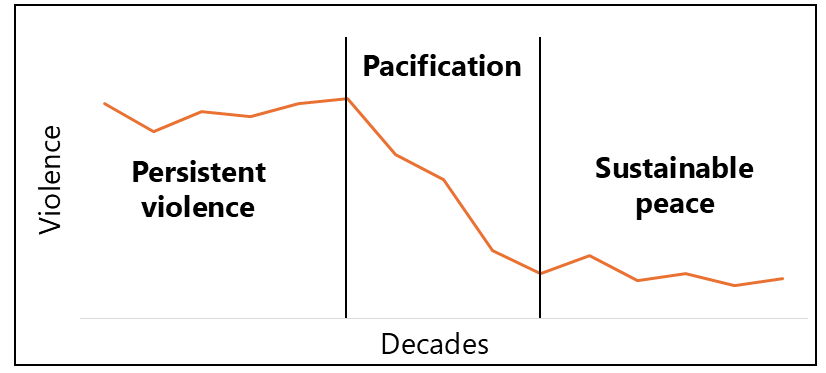
In this project, which aims to contribute to Decades of Peace, we ask a critically important question: How do societies move from persistent violence to sustainable peace?
Relevance
This question has immense practical relevance because persistent violence represents a major threat around the world. While violence – the deliberate infliction of harm – has generally declined over the centuries, many countries have not benefited from this decline. In Latin America, homicide remains a primary cause of death and the region has the globally highest levels of violence. Homicide and other forms of violence are often locally concentrated in marginalized areas and ingrained in their social structure. This structure consists of local institutions promoted by competing actors, including a locally weak state, communities, rebels, and gangs, and related individual expectations of distrust and fear, which facilitate the persistent use of violence. These institutions, expectations, and violence form a negative social equilibrium that is hard to change – an equilibrium of violence. A better understanding of how such an equilibrium of violence can be overcome is thus urgently needed.
The question also has major scientific relevance because answers remain limited. While the equilibrium of violence is a known problem, we know little about how to change it. Scholars in the fields of peace research, violence prevention, and historical analysis of violence have made important contributions to the study of violence reduction. However, research has often focused on organizational change, such as resolving disagreements between violent organizations, and individual behavior change in the context of prevention activities. Focusing attention on the problem of an equilibrium of violence makes clear that sustainable violence reduction requires more than organizational and individual change, it requires change at the societal level.
Theory
We contribute to this important question with a new theoretical approach based on an institutional understanding of violence and a focus on societal-level change. In areas where violence stubbornly persists, it is underpinned by competitive institutions and negative individual expectations sustaining an equilibrium of violence. To overcome this equilibrium, we propose a new theory of alignment between state and society. By alignment, we mean a process of developing common rules and shared expectations and values, which helps to break the negative equilibrium of persistent violence and create a new equilibrium of sustainable peace.
Research strategy
Our methodological approach consists of an integrated, multi-method research program. This approach captures both the evolution of violence at the structural level and the individual foundations of the alignment process. Particularly instructive are cases of local violence reduction in otherwise violent countries, observed over decades using trajectory analysis and historical comparative analysis. The role of expectations and values – the individual-level foundations of alignment – is studied with surveys and experimental evaluation tools.
Project goals
This project has the potential to contribute to a fundamental goal of human society: peaceful coexistence. To do so, the project has two key objectives:
First, develop a new theory on the process of alignment that explains how societies move from a social equilibrium of violence to sustainable peace, focusing on societal-level change.
Second, generate new evidence to systematically study processes of violence reduction and evaluate the structural and individual-level implications of the new alignment process theory.